Lucid dreaming 101
publish Related to Dreams (private page).

Lucid dreaming (LD) = being awake during a dream.
It’s highly entertaining (you get superpowers) and surprisingly low effort to learn (only 2 months for me).
Read on to learn how!
Part 1/3: Remembering the dream
Peer-reviewed science (like Nature) finds that humans really do experience dreams every night — we just forget them in the morning. So forgetfulness is the first obstacle you’ll need to overcome as a dreamer.
Learning to remember takes a few weeks of mild effort but you should start seeing results early on. All you need to do is write down your dreams first thing in the morning.
Some people online call this a “keeping a dream journal.”
 My Obsidian — each outgoing edge represents a dream record
But honestly, “keeping a journal” oversells the effort required. My so-called “dream journal” is just a collection of text notes on my phone, the majority of which were fire-and-forget — written once and never reread. You could certainly do more than I did. But FYI the bare minimum is fine.
Keep in mind as you journal: the goal of journaling is not to output a pristine, polished journal; it’s to incentivize your brain to care enough to remember. Without journaling or discussing your dreams with someone, there’s no incentive to lucidly recall them. Keeping a journal rewires this incentive structure so that dreams become “useful” to remember.
To say this even more simply: using your dream memories for something builds the remembrance muscle. Use your dream memories for something!
And, in case you’re curious, the maintenance cost of remembrance is fairly low. These days I rarely document my dreams (only about once per month, and only for really spectacular dreams) and I recall ~25% of my dreams. When I was super into lucid dreaming, journaling daily, I recalled close to 100%. YMMV.
Part 2/3: Triggering the dream
Having tried ~half a dozen methods of triggering lucidity, the one that worked for me was also the simplest: Finger Induced Lucid Dreaming (FILD).
FILD works by keeping your mind conscious while your body drifts off to sleep. To do this, you’ll use a gentle repeated motion with your index and middle fingers.
Here’s how to perform FILD (you can try these steps right now!):
- Gently rest one hand, palm-down, flat on a surface.
- Lightly press your index finger down, like you’re playing piano.
- Repeat the same motion with your middle finger.
- OK! Now repeat steps 2-3 as lightly as you possibly can.
- This motion is what you’ll use for FILD.
- You’ll know you’re doing it right if, looking at your fingers, they appear motionless.
 A totally flat palm isn’t necessary; your hand just needs to be completely relaxed like this
Lastly, here’s how you’ll use this motion to trigger a dream: at night, as you’re getting into bed, position your hand somewhere comfortable on your mattress. Do the FILD motion and count upwards from 0 to 150 (incrementing +1 per finger press).
What’s cool is, after reaching 150, you may actually be dreaming and just not know it. Do a reality check (RC) to find out! I’d recommend plugging your nose and trying to breathe through it. If you can breathe through a plugged nose… you are definitely asleep. And you’re super close to being done…
Part 3/3: After entering the dream
Even after succeeding at an RC, you’re probably not quite lucid. Entering a dream like this is boring so your mind may — even after repeated practice — often second guess you’re dreaming. “There’s no way this bedroom is a dream,” your sleepy brain typically tells itself. “I’d be able to tell. I should retry the FILD countdown. So all I need to do is put my hand back on the bed and close my eyes…”
Push through that feeling! It doesn’t make any sense! The sleeping mind often makes bizarre leaps of logic and you are not yet lucid if you’re still experiencing these. The final step to achieve lucidity in my experience is opening the bedroom door.
Disclaimer: It gets pretty subjective from here on out
Below, I’ll describe how my lucidity process goes virtually every time. Just know your personal experience may vary since lucid dreams are different for everyone.
Most of the time, walking to the bedroom door feels like you’re awake and is pretty easy. Uncommonly though, my brain creates obstacles to prevent me from making it there. These obstacles are usually one-offs (they happen once and never again — perhaps because I’d learn from them otherwise?) and have included fun gimmicks like:
- The bedsheets are waaay heavier than usual, so I give up trying to lift them
- Each time I blink, my body materializes back in bed. So I need to reach the door without blinking
- Halfway to the door, I become gripped by a paralyzing certainty that trying the door is a waste of time, and I’ll miss out on a real lucid dream unless I return to bed and retry FILD right now
When you finally arrive at the door though, I’m usually good. Universally what happens next is that I open it and find nothing on the other end. The “nothing” is some variation of a white void, a dark void, or a swirl mix like acrylic paint , but the visual is always dramatic enough to snap my brain into proper lucidity.
“Okay,” my brain seemingly agrees, “you make a fair point with the freaky door thing. I’m dreaming.”
After a few blinks, the white/black void quickly morphs into the entrance to a place. If I’m concentrating on somewhere particular, it’ll materialize into that. Otherwise it’ll take me somewhere random, usually a real location I’ve visited recently.
Worth noting: often times, thinking really hard about going somewhere will bring you there. I’ve heard this corroborated online so I think it means everyone’s unconscious mind is fairly suggestible. For me, the default spot I like is a familiar New England beach at sunset, where I spent my childhood visiting and can easily picture from memory. In my dream, the beach’s sky is painted impossibly deep shades of violet and crimson, which glimmers on perfectly-carved bands of golden sand.
Interestingly, this beach location appears ~20% of the time even when I’m not focusing on a place to go. This suggests that my early practice concentrating on the beach has rewired my brain somehow to prefer it. Neat.
You’re done!
That’s the process of becoming lucid!
What happens next: you can do almost anything. Flying is by far my favorite activity. Folks on the internet tend to agree — but now I can’t help but wonder if my enjoyment is self-fulfilling; that is, I only enjoy flying so much because online forum posts said I would, so my dreaming brain fabricated an experience perfectly tailored to my taste?
I guess in telling you this, I’ve prevented you from running your own unbiased flying experiment. Sorry about that. On the other hand: I’ve made your odds of enjoying flying much higher!
I shall stop biasing you here with fun things to try. If there’s any anticipated experiences you’d expect to enjoy and you end up trying them, please let me know how they go!
Experiments I’ve run / phenomena I’ve observed
Subconscious cause & effect
What’s fascinating is I’ve never enjoyed total control over my lucid dreams. A few sentences ago, I mentioned flying — but I can’t easily achieve it on command. Interestingly, my brain usually requires at least 1 degree of indirection. For examples:
- I conjure a set of Da Vinci-style mechanical wings, put them on, and use those to fly.
- I conjure a remote control to my hand with a single button on it — pressing that button grants me the power of flight, and then I can fly.
This consistent experience suggests my brain has an ingrained instinct to rarely suspect its disbelief without cause-and-effect. Maybe this is why I’m so critical of movies with bad writing (it’s not my fault Squid Game makes no sense!).
Weird, and neat.
Object impermanence
Several times, I’ve teleported myself into a library or barbershop and read some of the literature lying around. Then, I’ll look away from whatever I’m reading. Upon looking back: I can tell the contents of the book/magazine have changed — yet I can never recall the original. That’s kind of weird.
That this behavior appears consistently in my lucid dreams suggests there’s something deeper and weirder going on with (my?) memory. A consistent explanation might be that the mind uses fuzzy hashing of some kind to store unconscious memories?
NPCs
Characters in my dreams never have properly fleshed-out personalities. So conjuring up someone I know IRL would be virtually identical to conjuring up Abraham Lincoln — different coats of paint covering the same (or similar) underlying core personality.
This phenomenon is difficult to describe, but I’ll try: you know how Nintendo Miis all look kinda similar because they draw from the same pool of facial features?

It’s like that, except dream NPCs all draw from the same limited pool of personalities. Example personas:
- Really rushed, like they’re late for something and don’t have time to talk.
- Totally unbothered, and will universally go with the flow — including being told they’re a figment of my imagination.
- Hyperfocused on one particular thing, e.g. cooking if they happen to be in a kitchen, and it’s impossible to convince them to do anything else.
I wonder if this limited personality pool is in some way a reflection of the limits of my unconscious psyche. Do I pigeonhole people so much that my subconscious is doing it too?
Disappointingly, having only ultravanilla NPCs means I haven’t experienced any illuminating, Yungian dialogues with my unconscious self, as some people describe online. My NPCs usually just agree with me. They’re not great for conversation.
And, well, to take a logic view: this must mean my brain is fully enlightened. I can learn nothing more from introspection! If any clinics in California would like to hire an incredibly self-actualized unlicensed therapist with no degree — I offer very affordable rates; please reach out.
Creative dreams
I make artsy stuff fairly regularly and have tried leveraging lucid dreams as a tool to inspire myself. It works… sorta. By now I’m certain I’ve drawn things I’ve only ever seen in dreams, but I can’t tell if I did so as a result of the dream, or that I only recognize the thing I drew as a dream-object after having already drawn it.
Example messy doodle:
 There’s something about motion-without-motion here that’s reminiscent of a dream
So I can’t really comment that it works or doesn’t work. I’ve also not pursued this very much since it would mean applying a more aggressive approach to my art. Call it an active area of research!
As an aside: I’ve heard impossibly beautiful melodies in dreams that I’ve tried to translate to music upon waking — but never successfully done it, possibly because I don’t have a strong enough music background (only mildly practiced guitar in college).
Lack of time dilation
AFAICT, Inception-style time dilation — that 20 hours in the dream is 1 hour in real life — is BS (great movie though!). Time in dreams passes at the same rate as in the waking world.
I’ve measured this by setting pretty aggressive timers in the waking world, then achieved a 15 minute lucid dream that indeed felt like 15 minutes in the dream world. Myth = busted.
Improving your odds of LDing
Hopefully the above piques your interest enough to try lucid dreaming! Please let me know how it goes, fellow psychonaut.
If FILD doesn’t end up working for you right off the bat, though consider adding these adjustments…
Be as tired as possible (without ruining your sleep schedule)
Sorry, this is sort of an unfair recommendation because you can’t organically force tiredness to happen. What I mean is: set realistic expectations about which nights you’ll probably LD.
You’re not always going to be dead tired, and when you’re not dead tired you’re not going to slip into REM sleep (dreaming sleep) as smoothly.
For reference: REM sleep occurs at a few stages of the sleep cycle…
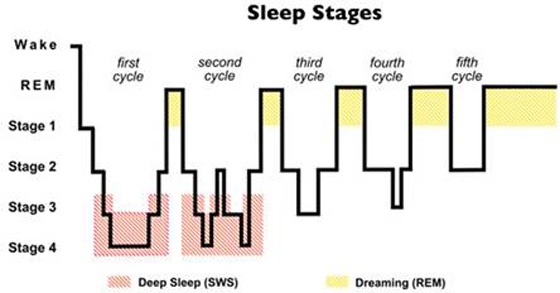
… and for the FILD technique, we’re targeting lucidity right at the very start, on the left side of “first cycle”.
To rephrase another way: if you’re lazy and only want to attempt LDing when your odds are best to succeed: try on the nights when you’re extra tired following a period of consistent bedtime.
And don’t force yourself to be tired by sleeping super late! This makes LDing more difficult by making your REM stage less predictable — I usually fall asleep too quickly.
Getting tired through exercise sorta helps though. But of course, you should be exercising anyway. Coming soon: Warren’s guide on How to exercise
(Also, fun fact: waking during REM sleep typically causes you to remember dreams more often and generally have a smoother waking experience. You can do this by configuring a special REM-based alarm app using a smartwatch monitoring your heartbeat… I did this using “Sleep as Android,” but I’m sure that 90% of my readers are iPhone users, so not worth documenting 🤠)
Waking up in the middle of the night to induce tiredness
This technique is called WBTB (“Wake-Back-To-Bed”). I’ve found a bit of success with it and would recommend.
What you do is: set an alarm for the middle of the night (give yourself like 4.5-5h of sleep), wake up for a short period of time (5-30 min; you can play around with this), and then immediately doze off while reattempting a lucidity technique.
For me, WBTB works especially well for short naps. In that scenario: I set an alarm for ~30 minutes, doze off while attempting FILD, wake up from my (hopefully lucid) dream, set another +30 min time, reattempt FILD, … etc.. Even if you don’t LD, simply remembering your naptime dreams is a good sign that you’re making progress on the dream journal side of things.
Another technique: MILD
MILD = Mnemonic Induced Lucid Dreaming.
Unfortunately MILD didn’t work for me- but it comes highly recommended so maybe it’ll work for you. The idea is to train your brain to passively recognize when it’s dreaming, thereby eliminating the primary issue with FILD: that it either works instantly or not at all. With MILD, you’ll recognize you’re dreaming while in the dream, effectively giving you infinite shots at inducing an LD.
The way MILD-users say their technique works is by inducing a gentle dream paranoia in the waking world. You do reality checks like half a dozen times per day while awake so you’re always aware of whether you’re dreaming.
This struck me as an awful lot of effort and awkward nose plugging, but check out this Reddit post if you want to learn more.
Misc notes that didn’t find a place in this article
Any fun stories?
My funniest one was the first time I achieved lucidity. I had just finished plugging my nose, breathing through it, and realizing I was asleep. “I wonder if I can make myself wake up?”
Yes. Yes, you can.
The second time I achieved lucidity was sorta related to this. I had just finished watching The Ring (horror movie). So, when I achieved lucidity, I found my bedroom door led to a black void with nothing but a water well (where the monster in the movie comes from). I noped out of that dream super quickly. Glad I learned I can wake myself up!
Other fun stories involve enrolling in Hogwarts and zipping around on a broomstick.
The “Lightning” sensation when falling asleep
Usually, falling into lucidity is sensationless, but like 1/7(?) times I’ll get a zapping sensation running through my whole body. It feels like a warm wave of lightning. Not unpleasant, but definitely surprising.
Any impact on sleep quality?
Nope! Go nuts!
Anything to avoid?
Just /r/luciddreaming, lol. With one exception: their wiki is a good resource.
Everything else on that sub is some variant of: (1) terrible advice, (2) gimmicks that may reverse your hard-earned progress like doomscroll induced lucid dreaming, and (3) people asking “DAE sex when lucid dreaming??”
Did you say SEX
Yeah it’s 100% possible.
Fun, but personally I found it weird that dreaming a sexual fantasy is basically Obsession (2025)-ifying an NPC into being an object of desire. That feels kinda inhuman/nonconsensual/etc./etc./maybe I’m just projecting something Freudian by saying this idk. You’re not hurting anyone though so go for it.
Sleep paralysis
I’ve only had it happen once in 5+ years. So, I’m biased in saying it’s not a problem but — even when I had it, I didn’t think it was much of a problem. I agree it’s freaky to be paralyzed in your own body, but that’s basically what a rollercoaster is (btw: I hate rollercoasters) and it’s over quickly.
My one sleep paralysis incident involved hallucinating a giant heavy shadow dog sitting on my chest really close to my face. Spooky but only lasted ~15 seconds.
Thanks for reading
And let me know if you have any experiment suggestions or end up learning to LD! I’d love to chat with someone who successfully has a Yungian dialogue — I’m really jealous of the people online who can do it.